 CHAT WITH US NOW!

This Thailand vs Vietnam comparison guide will help you compare travel costs, food offerings, infrastructure & connectivity, and much more.
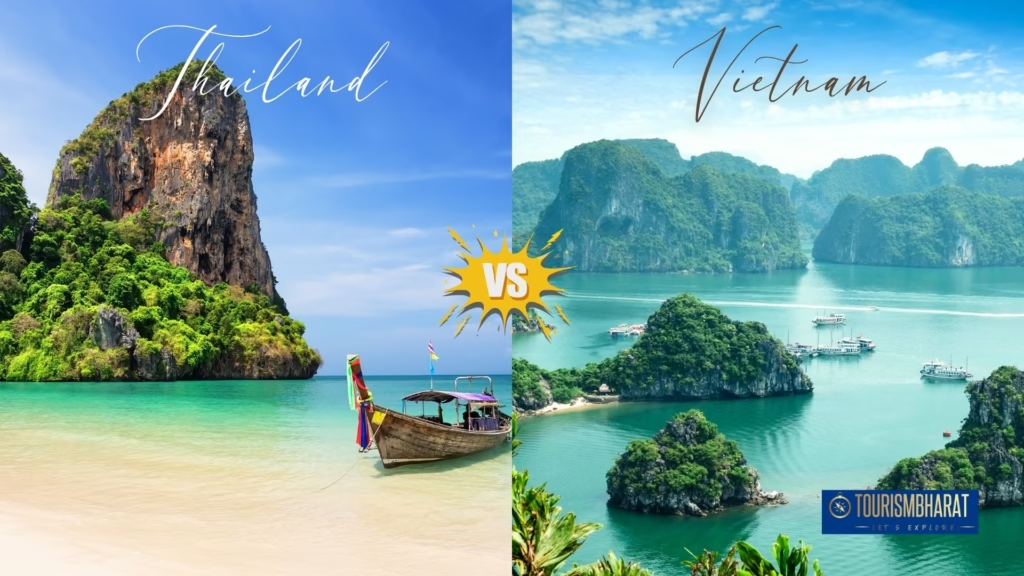
Deciding between Thailand and Vietnam for your next Southeast Asian adventure is one of the most exciting yet challenging travel dilemmas. While both countries share geographic proximity, rich spiritual heritages, and legendary street food scenes, they offer fundamentally different travel experiences. Thailand is a polished, tourism-optimised paradise boasting glittering golden temples, world-class luxury resorts, and a deeply entrenched visitor infrastructure. Vietnam, on the other hand, is a raw, dynamic, and historically profound sensory wonderland characterised by dramatic karst mountains, French colonial architecture, and an energetic, fast-paced local lifestyle.
Whether you are seeking pristine turquoise bays, deep cultural immersion, or a budget-friendly digital nomad base, this authoritative, side-by-side comparison reveals which destination aligns perfectly with your travel style, budget, and expectations.
Thailand vs Vietnam: The Ultimate Side-by-Side Comparison Matrix
Direct Answer: Thailand is the undisputed winner for idyllic beaches, pristine sand, and robust tourism infrastructure, whereas Vietnam excels in historical depth, rugged mountain landscapes, and exceptional value. While Thailand is highly Westernized and easy to navigate, Vietnam offers a raw, sensory-rich adventure.
To understand the high-level differences between these two titans, we must look at how they approach tourism. Thailand has spent over four decades perfecting its hospitality industry. From the moment you land at Bangkok’s Suvarnabhumi Airport, the tourist journey is seamless. Vietnam is catching up rapidly, but it retains a wilder, more spontaneous edge that appeals to travellers seeking raw exploration.
This contrast is highly visible in their natural wonders. If you are choosing between deep jungle adventures, compare Khao Sok National Park in Southern Thailand to the Phong Nha-Ke Bang caves in Central Vietnam. Khao Sok features ancient rainforests, limestone towers rising from Cheow Lan Lake, and accessible floating luxury bungalows. Conversely, Phong Nha-Ke Bang is a subterranean wonderland housing the world’s largest caves (including Hang Son Doong). Exploring Phong Nha requires rigorous physical trekking, licensed local guides, and permits secured months in advance through specialised operators like Oxalis Adventure.
A similar divergence exists in their island logistics. Consider Koh Kood (Thailand) versus Phu Quoc (Vietnam). Koh Kood is a sleepy, undeveloped paradise of powdery white sand and low-slung boutique eco-resorts, accessible via a coordinated train/bus and ferry route from Bangkok to Trat. Phu Quoc is an energetic, highly developed island with a dedicated international airport, massive theme parks, and an e-visa-free entry scheme, but its public beaches feature coarser sand and are far more commercialised.
Seasonality & Weather Matrix
To help you plan your departure, this table outlines when to visit each country to ensure blue skies and avoid monsoon-heavy washouts.
| Region / Country | Best Months to Visit | Average Temperature Range | Rainfall & Monsoons | Crowd Levels |
|---|---|---|---|---|
| Thailand (Andaman Coast – Phuket/Phi Phi) | November to April | 28°C – 34°C | Heavy monsoons May to October | High (Dec-Jan); Low (Jun-Sep) |
| Thailand (Gulf Coast – Samui/Tao) | January to August | 27°C – 35°C | Heavy rainfall October to December | Moderate to High year-round |
| Northern Vietnam (Hanoi/Sapa) | September to November; March to May | 15°C – 28°C (Can drop to 5°C in Sapa in Jan) | Wet summers; dry, chilly winters | Moderate |
| Central Vietnam (Hoi An/Da Nang) | January to July | 24°C – 35°C | Typhoon season September to November | High (Apr-Jun) |
| Southern Vietnam (HCMC/Mekong) | December to April | 30°C – 35°C | Heavy afternoon downpours May to November | Consistent year-round |


Detailed Cost Comparison: Daily Budgets for Backpackers, Flashpackers, and Luxury Seekers
Direct Answer: Vietnam is roughly 15% to 25% cheaper than Thailand. A mid-range 14-day budget for Vietnam averages $800 to $1,200 USD per person, whereas Thailand ranges from $1,100 to $1,600 USD, primarily due to Thailand’s higher domestic transport fees, island premiums, and alcohol taxes.
While both destinations offer incredible value compared to Europe or North America, your money will stretch significantly further in Vietnam. This price gap is most pronounced in daily incidentals, local beers, and domestic transportation. In Vietnam, a fresh draft beer (Bia Hoi) on a Hanoi street corner costs as little as $0.30 USD (25 INR), whereas a local Singha or Chang beer in a Thai convenience store starts at $1.50 USD (125 INR) and doubles in bars.
Accommodation in Vietnam also provides remarkable value. High-quality homestays and stylish boutique hotels in destinations like Hoi An or Hanoi cost a fraction of their equivalents in Bangkok or Chiang Mai. Thailand’s southern islands command a heavy premium; food, transport, and lodging on Koh Samui or Phuket can easily double your daily expenditure compared to mainland Thailand or any part of Vietnam.
Budget & Category Breakdown (INR & USD)
The following comparison table details estimated daily expenses for both countries across different travel styles. (Note: Conversion rates calculated at 1 USD = 83.50 INR).
| Travel Style | Vietnam (Daily Budget) | Thailand (Daily Budget) | Key Cost Drivers & Differences |
|---|---|---|---|
| Backpacker (Budget) | $25 – $35 USD (approx. ₹2,100 – ₹2,900 INR) |
$35 – $50 USD (approx. ₹2,900 – ₹4,100 INR) |
Vietnam offers cheaper hostels and incredibly cheap street food. Thailand’s island longtail boats and national park entrance fees inflate budget travel. |
| Flashpacker (Mid-Range) | $60 – $100 USD (approx. ₹5,000 – ₹8,350 INR) |
$80 – $130 USD (approx. ₹6,700 – ₹10,850 INR) |
Private rooms in gorgeous boutique hotels and daily sit-down meals are highly affordable in Vietnam. Thailand’s domestic flights and western-style cafes add up. |
| Luxury (High-End) | $200+ USD (approx. ₹16,700+ INR) |
$350+ USD (approx. ₹29,200+ INR) |
Thailand is home to legendary, ultra-luxury brands (Aman, Six Senses, Four Seasons) with matching price tags. Vietnam’s luxury sector (e.g., InterContinental Danang) is world-class but generally priced lower. |
Which Country Fits Your Vibe? The TourismBharat Segment Guide
To help you choose, our destination specialists have mapped both countries to specific traveller profiles:
- Couples & Honeymooners: Thailand wins. The private pool villas of Koh Samui, sunset cruises in Phang Nga Bay, and premium wellness spas offer unmatched romance.
- Families: Thailand wins. Highly developed family resorts with kids’ clubs, gentle swimming beaches in Krabi, and easy transit make it stress-free.
- Solo Travellers: Tied. Thailand’s established “banana pancake trail” makes socialising effortless. Vietnam offers incredibly safe, deeply engaging hostel cultures with organised group loop rides (e.g., the Ha Giang Loop).
- Adventurers & Hikers: Vietnam wins. Trekking through the rice terraces of Sapa, motorcycling the northern frontier, and exploring massive river cave systems are world-class experiences.
- Corporate & MICE Groups: Thailand wins. Bangkok and Phuket boast massive, state-of-the-art convention facilities, premium team-building agencies, and high-capacity luxury hotels.
Food Fight: Street Food Culture, Iconic Dishes, and Food Safety Standards Compared
Direct Answer: Thai cuisine is characterized by bold, fiery, and complex flavor profiles dominated by lemongrass, chili, and coconut milk. Vietnamese cuisine champions fresh herbs, subtle balances of sweet, sour, and salty, and lighter broth-based dishes. Both have excellent street food, but Thailand has slightly stricter commercial hygiene practices.
The culinary battle between Thailand and Vietnam is legendary. Both nations live and breathe food, and in both, the street-side plastic-stool culture is where the magic happens. However, their flavour philosophies are polar opposites.
Thai cuisine is unapologetic. It utilises intense heat, heavy garlic, fermented shrimp pastes, and rich coconut curries to create a symphony of sweet, salty, spicy, and sour flavours. Vietnam’s culinary profile is far more delicate, fresh, and herb-forward. Dishes are rarely spicy on their own; instead, they are served with a side of fresh bird’s eye chillies, lime wedges, and mountains of fresh mint, coriander, and Thai basil so the diner can customise the flavour profile.
The Noodle Showdown: Khao Soi vs. Cao Lau
To understand this culinary divergence, look at two iconic regional noodle dishes:
- Khao Soi (Northern Thailand): A deeply aromatic, creamy coconut curry soup base containing tender chicken or beef, served over soft egg noodles and topped with crispy fried noodles, pickled mustard greens, raw shallots, and chilli oil. It is rich, heavy, complex, and intensely satisfying.
- Cao Lau (Hoi An, Vietnam): A historic, dry noodle dish featuring thick rice noodles that must be mixed with water drawn from the ancient, local Ba Le Well, mixed with wood ash from local Cham Island trees. This process gives the noodles a chewy, smoky texture. It is topped with tender slices of five-spice pork, fresh local greens, crispy rice crackers, and a splash of intensely savoury pork broth. It is light, incredibly localised, and historically complex.
When it comes to food safety, both countries are safe for adventurous eaters if you follow basic precautions (eat where locals queue, ensure meats are cooked fresh to order, and drink bottled water). However, Thailand’s tourism-heavy zones have slightly more regulated commercial food safety standards, and ice served in licensed Thai restaurants and street stalls is almost universally produced in hygienic commercial facilities.
Infrastructure & Connectivity: Which Country is Better for Digital Nomads?
Direct Answer: Thailand is the superior hub for digital nomads and remote workers due to its fast fiber-optic internet, abundance of modern coworking spaces, and the newly introduced 5-year Destination Thailand Visa (DTV). Vietnam’s 90-day e-visa is highly accessible but lacks long-term structural nomad support.
For remote workers and digital nomads, Thailand has long reigned supreme. Bangkok and Chiang Mai consistently rank among the top digital nomad cities globally, thanks to blazing-fast internet speeds, exceptionally chic cafes with power outlets, and fully equipped coworking spaces.
Vietnam is a rising star in this space, with Da Nang, Hanoi, and Ho Chi Minh City sporting highly active nomad communities. However, Thailand has taken a massive regulatory leap forward with its visa offerings.
Visa Requirements: Thailand vs. Vietnam
- Thailand’s Visa Framework: Thailand offers visa-exempt entry for up to 60 days to citizens of over 90 countries. For remote workers, digital nomads, and cultural tourists, the newly introduced Destination Thailand Visa (DTV) is a game-changer. It allows a 5-year multi-entry stay, permitting 180 days per entry (extendable for another 180 days), provided you can prove remote employment or registration in cultural activities (like Muay Thai or culinary schools) and show a minimum bank balance of 500,000 THB (~$13,600 USD).
- Vietnam’s Visa Framework: While select European and Asian nations enjoy short visa-exempt stays (typically 15 to 45 days), most travellers must apply for the Vietnam 90-day multi-entry e-visa online. It costs between $25 and $50 USD and takes 3 to 5 business days to process through the official government portal. While great for extended travel, Vietnam does not currently offer a dedicated, long-term legal digital nomad visa equivalent to Thailand’s DTV.
Cellular Connectivity
To stay connected, setting up an e-SIM prior to arrival is highly recommended. In Thailand, AIS is the premier network provider, offering unmatched 5G speeds, particularly across remote southern islands like Koh Lipe. In Vietnam, Viettel (the state-owned military telecom operator) provides incredible coverage, ensuring robust 4G/5G connections even in deep northern mountain passes like Ha Giang and Sapa.
Getting Around: Navigating Local Transport, Trains, and Ride-Hailing Apps
Direct Answer: Thailand has a more developed, comfortable, and reliable domestic transport network, including comfortable sleeper trains and efficient domestic flights. Vietnam is highly affordable and boasts scenic train journeys, but navigating local traffic requires using regional ride-hailing apps like Grab, Gojek, or Be.
Getting around both countries is incredibly affordable, but the experience differs dramatically. Thailand’s long-distance transport is comfortable and highly organised. Vietnam’s transport is highly adventurous, featuring legendary coastal rail routes and cheap domestic air carriers.
The Sleeper Train Showdown
For long journeys, overnight sleeper trains are highly popular in both countries:
- Thailand’s SRT Class 2 Sleeper Trains: Operated by the State Railway of Thailand, these trains are exceptionally clean, air-conditioned, and feature comfortable bunk beds that are converted from day seats by professional staff. Tickets can be easily booked online via the official D-Ticket portal.
- Vietnam’s Private Sleeper Carriages (e.g., Laman Express or Lotus Train): In Vietnam, the state-run Reunification Express trains are often retrofitted with privately run, luxury tourist carriages like the Laman Express or Violette Express. These feature wood-panelled cabins, soft bedding, complimentary snacks, and traditional Vietnamese decor, providing a far more atmospheric, colonial-era feel than Thailand’s modern trains.
Ride-Hailing Apps: Grab vs. Gojek vs. Be
Do not rely on traditional street taxis, which frequently attempt to overcharge tourists. Instead, download these essential ride-hailing apps:
- Thailand: Grab is the dominant player for both cars and motorbikes. Bolt is also widely available and often cheaper, though pickup times can be longer.
- Vietnam: Grab remains highly popular, but it faces fierce, ultra-competitive pricing from Gojek and Be (a highly popular local Vietnamese ride-hailing and delivery app). Motorbike taxis (GrabBike) are the fastest way to slice through rush hour traffic in Hanoi and Saigon, costing less than $1 to $2 USD per trip.
Transit & Logistics Cheat Sheet
Flight Connectivity: Thailand’s Suvarnabhumi Airport (BKK) and Don Mueang (DMK) are massive international transit hubs, offering direct flights to virtually every corner of the globe. Vietnam’s Tan Son Nhat (SGN) in Saigon and Noi Bai (HAN) in Hanoi have expanded rapidly, offering excellent direct connections across Asia, Europe, and Australia.
Vetted Cab Transfers: To avoid airport taxi queues and language barriers, TourismBharat partners with premium, English-speaking local drivers. You can pre-book vetted private transfers from Bangkok to Pattaya/Hua Hin, or from Da Nang Airport to Hoi An old town directly through our booking portal.
Cultural Etiquette & Critical Local Laws
To avoid serious legal trouble or offending your hosts, keep these distinct cultural differences in mind:
- Lèse-majesté Laws in Thailand: Thailand has incredibly strict Lèse-majesté laws. It is a severe criminal offence to criticise, mock, or deface any image of the Thai Royal Family—this includes stepping on a Thai Baht coin (which bears the King’s face) to stop it from rolling away. Always show utmost respect to royal portraits.
- War History Sensitivity in Vietnam: When visiting historic sites in Vietnam, such as the War Remnants Museum in Ho Chi Minh City, the Cu Chi Tunnels, or the Hoa Lo Prison in Hanoi, maintain quiet, sombre respect. Avoid wearing highly revealing clothing at these locations, and refrain from initiating heated debates regarding the geopolitical history of the Vietnam War.
- Temple Etiquette (Both Countries): When entering Buddhist temples in Thailand or Pagodas in Vietnam, you must dress modestly. Both shoulders and knees must be fully covered (carrying a sarong is highly useful), and you must remove your shoes before stepping into sacred inner chambers.
Monsoon Seasons and Typhoons: When to Visit Which Country to Avoid Washouts
Understanding the weather systems of these two countries is critical to preventing a rained-out vacation. Thailand has two main monsoonal shifts. The southwest monsoon hits the Andaman Coast (Phuket, Krabi, Phi Phi) from May to October, bringing heavy downpours. However, the Gulf of Thailand (Koh Samui, Koh Phangan, Koh Tao) experiences its wet season later, from October to December. This means you can find a sunny Thai island almost any month of the year.
Vietnam is far more complex due to its elongated shape, stretching across three distinct climate zones. Northern Vietnam gets cold and misty in the winter (December to February) and hot and rainy in the summer. Central Vietnam (Hue, Hoi An) is highly susceptible to severe typhoons and flooding from September to November. Southern Vietnam remains hot year-round but experiences daily, heavy afternoon downpours from May to November. If you plan to travel from north to south in Vietnam, expect to experience multiple completely different weather patterns in a single trip.
Thailand vs Vietnam: The Final Verdict
Both nations offer incredible experiences, but your choice ultimately comes down to your personal travel desires:
Choose Thailand if: You want postcard-perfect tropical beaches, vibrant luxury island resorts, incredibly bold culinary flavours, and a smooth, highly developed travel infrastructure where everything “just works.” It is the ideal choice for first-time visitors to Asia, family vacationers, and digital nomads seeking a highly comfortable, long-term lifestyle.
Choose Vietnam if: You seek dramatic mountain passes, a deep and moving history, highly affordable boutique accommodations, and an energetic, culturally raw adventure. It is the perfect choice for backpackers, outdoor enthusiasts, motorcyclists, and foodies looking to explore a country that feels remarkably alive and beautifully authentic.
Let TourismBharat Craft Your Perfect Southeast Asian Getaway
Whether you want to lounge on the pristine sands of Koh Lipe or conquer the dramatic loops of Northern Vietnam, our expert travel designers are here to help. We build bespoke, hand-crafted itineraries, secure verified luxury accommodations at exclusive insider rates, and arrange vetted private transfers.