 CHAT WITH US NOW!

Discover Vande Bharat train routes, pricing, and features. Experience the future of Indian rail travel with this revolutionary train.
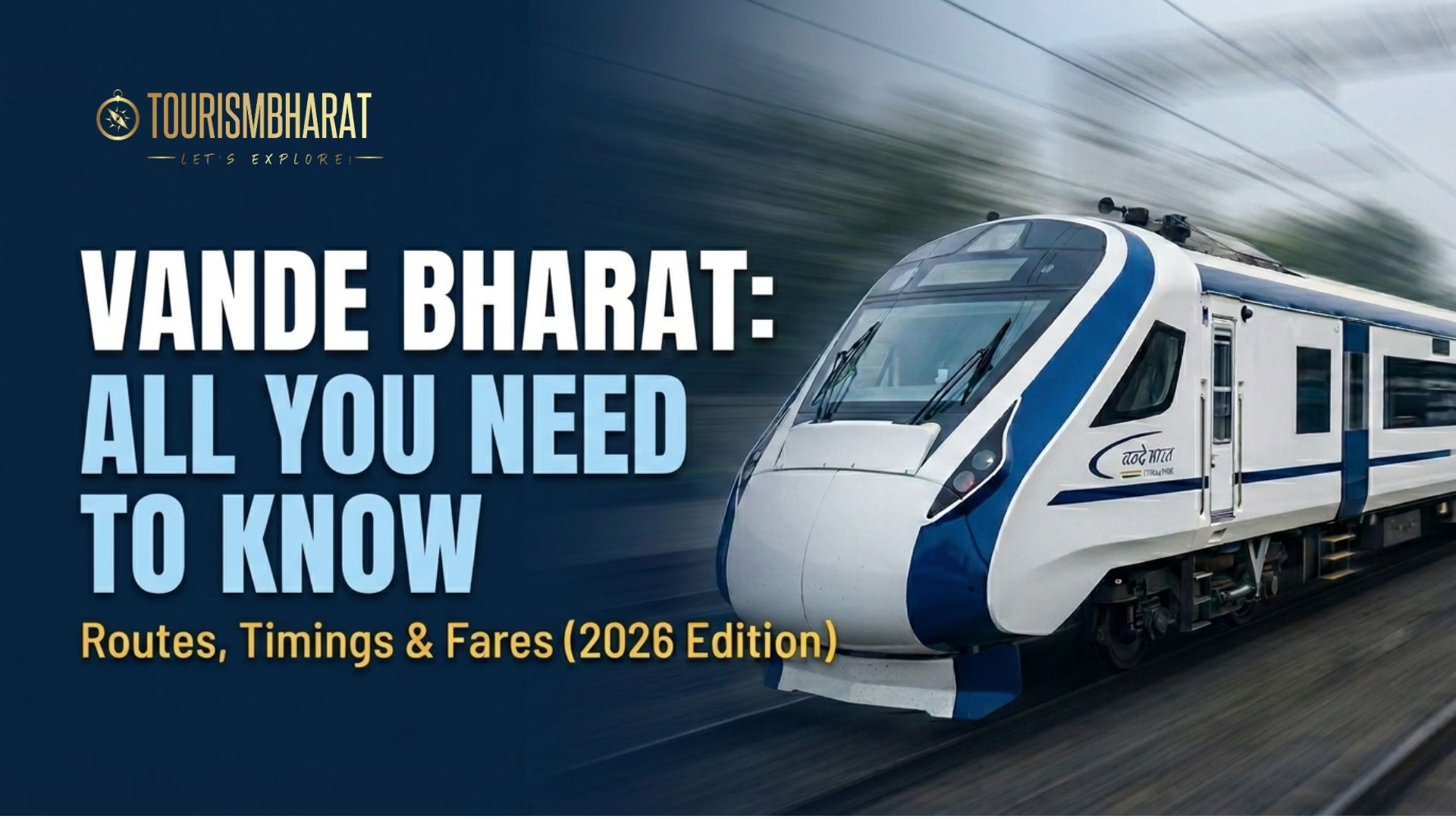
The landscape of Indian Railways is undergoing a monumental transformation. Gone are the days when train travel in India was solely associated with sluggish journeys, rattling coaches, and endless delays. Today, a new era has dawned, characterised by sleek, aerodynamic designs, lightning-fast acceleration, and aircraft-like comfort. At the forefront of this rail revolution is the Vande Bharat Express.
Whether you are a daily commuter, a business traveller, or a tourist eager to explore the diverse landscapes of the subcontinent, the Vande Bharat train has redefined what it means to travel by rail in India. From its inception as a bold indigenous project to its current status as the pride of the nation, this semi-high-speed train is a symbol of a modernised, ambitious India.
In this comprehensive guide, we will dive deep into everything you need to know about this engineering marvel. We will explore its fascinating history, untangle the intricate routes it operates on, break down the ticket pricing, and take a closer look at the luxurious amenities that make it a favourite among modern travellers.
The Genesis of a Revolution: From Train 18 to Vande Bharat
To truly appreciate the Vande Bharat Express, we must first look back at its origins. Before it was officially named Vande Bharat, the project was widely known by its developmental codename: Train 18.
The name “Train 18” was derived from the target year of its launch—2018. The vision was audacious: to design, develop, and manufacture a world-class, semi-high-speed train entirely within India, in just 18 months. Traditionally, importing such sophisticated train sets from Europe or Japan would take years and cost a fortune.
The Make in India Impact on Railways
The success of this project is a shining testament to the impact of Make in India on railways. By localising the supply chain and relying on the brilliance of Indian railway engineers, the production cost of the train was brought down to nearly half of what an imported equivalent would cost. This localised manufacturing didn’t just save money; it stimulated the domestic economy, created specialised manufacturing jobs, and proved that Indian engineering could compete on a global scale.
The heart of this manufacturing miracle took place in southern India. The Integral Coach Factory Chennai production lines worked tirelessly, breaking away from conventional locomotive-hauled coach designs to create a self-propelled Electric Multiple Unit (EMU). This meant there was no separate engine pulling the train; instead, the propulsion system was distributed across the passenger coaches, allowing for faster acceleration and deceleration.
Engineering Marvels: Decoding the Technology
What makes this train so different from the thousands of other trains crisscrossing the Indian subcontinent? The answer lies beneath the floorboards and within the sleek aerodynamic nose cone.
When engineers drafted the initial Train 18 technical specifications, their primary goal was to drastically reduce travel time without needing to lay completely new, dedicated high-speed tracks. By utilising distributed power, the train can reach its top speed much faster than traditional trains and brake just as quickly when approaching a station or a speed restriction.
Speed and Power
When discussing the maximum speed of modern Indian rakes, the Vande Bharat currently holds the crown. While the train sets have been successfully tested at thrilling speeds of up to 180 km/h during trial runs, their operational maximum speed is currently capped at 130 km/h to 160 km/h, depending on track conditions and signalling infrastructure on specific routes.
Sustainability and Efficiency
One of the most impressive technical aspects of the Vande Bharat train is its commitment to sustainability. The train utilizes energy efficient regenerative braking technology. In layman’s terms, when the train applies its brakes, the electric motors act as generators. The kinetic energy of the moving train is converted back into electrical energy and fed back into the overhead power grid. This brilliant system saves up to 30% of electrical energy compared to conventional trains, making it a highly eco-friendly mode of transport.
Tip for Rail Enthusiasts and Creators: If you are a student, digital creator, or rail fan putting together a presentation or video about sustainable transport, finding a high-quality Vande Bharat Express png online with a transparent background is a great way to cleanly showcase the aerodynamic, energy-saving nose cone design in your projects.
Redefining Comfort: Top Features of the Vande Bharat Train
Step inside a Vande Bharat Express, and you might briefly forget you are on a train. The interior design draws heavy inspiration from modern commercial airliners, focusing on aesthetics, ergonomics, and passenger convenience.
A Tech-Forward Cabin
The moment you board, the differences are stark. Passengers are welcomed by automatic sliding doors and rotating chairs, eliminating the struggle with heavy, jamming manual doors found on older trains. The interconnecting doors between coaches are also sensor-operated, ensuring a quiet, dust-free, and air-conditioned environment throughout the train.
Above the seating areas, you will find screens displaying a real-time GPS passenger information system. This system keeps travellers updated on the train’s current speed, the upcoming stations, distance remaining, and expected time of arrival.
Unmatched Hygiene and Convenience
Indian Railways has made massive strides in sanitation, and the Vande Bharat features top-tier bio-vacuum toilets, similar to those found on aeroplanes. These toilets are odour-free, use significantly less water, and maintain a high standard of hygiene.
Other notable passenger features include:
- Onboard Wi-Fi: While meant primarily for entertainment (providing access to pre-loaded movies, music, and shows via a local network), it keeps passengers engaged during long journeys.
- Charging Ports: Every seat is equipped with mobile and laptop charging sockets.
- Personalised Reading Lights: Touch-operated LED lights are available for every passenger.
- Concealed Roller Blinds: Large, expansive windows come with sleek roller blinds instead of traditional curtains, giving a cleaner, more modern look.
- Divyang-Friendly Amenities: The trains feature braille seat numbers and specially designed wheelchair-accessible restrooms in specific coaches.
Safety First: Advanced Protection Systems
Speed and comfort mean nothing without safety. Recognising this, the Indian Railways integrated some of the most advanced safety protocols in the world into this new fleet. The safety features of self-propelled train sets are vastly superior to traditional rakes, primarily because the advanced electronics allow for automated interventions.
The Kavach System
The most significant safety upgrade is the integration of Kavach. The Kavach anti-collision system benefits are revolutionary for Indian Railways. Kavach (which translates to “Armour”) is an indigenously developed Automatic Train Protection (ATP) system.
How does it work?
- Signal Passing at Danger (SPAD) Prevention: If a loco pilot accidentally jumps a red signal, Kavach automatically takes control and applies the brakes to stop the train.
- Collision Avoidance: If two trains equipped with Kavach are detected on the same track heading toward each other, the system automatically halts both trains at a safe distance.
- Speed Control: It continuously monitors train speed and automatically applies brakes if the train is going too fast around a curve or a speed-restricted zone.
In addition to Kavach, the train boasts fire survival cables, a comprehensive fire and smoke detection system, and disaster management lights that illuminate automatically in the event of a power failure. Furthermore, all coaches are monitored by CCTV cameras, and emergency talk-back units allow passengers to communicate directly with the train crew in case of a medical or security emergency.
Comparing the Best: Shatabdi vs New Indigenous Trains
For decades, the Shatabdi Express was the undisputed king of daytime, inter-city travel in India. Introduced in 1988, Shatabdi trains offered air-conditioned comfort, complimentary meals, and priority routing. So, how does the new kid on the block compare to the seasoned veteran?
When analyzing Shatabdi vs new indigenous trains like the Vande Bharat, several distinct differences highlight the generational leap in technology:
- Propulsion: Shatabdi trains are hauled by a separate locomotive (either electric or diesel) at the front. The Vande Bharat is a self-propelled EMU. This distributed power allows the Vande Bharat to accelerate and decelerate much faster, saving considerable time on routes with multiple stops.
- Ride Quality: The Vande Bharat features fully suspended traction motors and advanced bogie designs, resulting in a much smoother, jerk-free ride compared to the older LHB coaches of the Shatabdi.
- Aesthetics and Windows: Vande Bharat offers continuous window glasses that provide a panoramic view of the landscape, vastly superior to the smaller, separated windows of the Shatabdi.
- Doors: Shatabdi relies on manual doors, which are often left open during the journey, leading to loss of air conditioning and safety risks. Vande Bharat’s automatic sliding doors lock centrally once the train is in motion.
- Turnaround Time: Because the Vande Bharat has driver cabins at both ends, it does not require a locomotive reversal at terminal stations. The driver simply walks to the other end, drastically reducing turnaround time.
While the Shatabdi remains a beloved and highly reliable service, the Vande Bharat represents the inevitable and necessary evolution of premium rail travel.
Class Divisions: Executive Class Versus Chair Car Facilities
The Vande Bharat Express operates entirely as an air-conditioned daytime seating train, akin to the Shatabdi model. It does not feature sleeper berths (though a sleeper variant is currently in production). The train is divided into two distinct classes, allowing passengers to choose a tier that fits their budget and comfort needs.
AC Chair Car (CC)
The standard Chair Car constitutes the majority of the train. It is designed in a 3×2 seating layout.
- Seats: The seats are plush, highly ergonomic, and can recline to a comfortable angle.
- Legroom: The legroom is generous, easily accommodating taller passengers without feeling cramped.
- Amenities: Drop-down tray tables, bottle holders, and overhead luggage racks.
- Best for: Solo travellers, families on a budget, and standard business commutes.
Executive Class (EC)
For those willing to spend a bit more, the Executive Class offers a premium, business-class experience. The seating arrangement here is a spacious 2×2 layout.
- The Rotating Seats: The most famous feature of the Executive class versus chair car facilities is the 180-degree rotating seats. Passengers can rotate their seats to face the direction of travel, or turn to face their family members or business partners to create a private four-seater pod.
- Space and Upholstery: The seats are wider, heavily cushioned, and covered in premium materials. The legroom is massive, featuring extended calf rests.
- Exclusivity: With fewer seats per coach, the Executive Class is quieter, making it ideal for working on a laptop or taking a nap.
A Culinary Journey: Onboard Catering and Menu Options
A major highlight of premium train travel in India is the food, and the Vande Bharat does not disappoint. The onboard catering and menu options are curated by IRCTC to provide a mix of standard continental fare and highly localised regional delicacies.
Meals are usually included in the ticket price (unless you explicitly opt out during the booking process). The food is prepared in base kitchens and loaded onto the train, kept hot in the state-of-the-art pantry equipment available in each coach.
What to Expect on Your Plate
Depending on the time of your journey, you will be served a combination of the following:
- Morning Tea/Coffee: Shortly after departure, passengers are greeted with a welcome drink, usually a choice of hot tea or coffee served in branded, eco-friendly thermos flasks, accompanied by biscuits or cookies.
- Breakfast: A typical vegetarian breakfast might include poha, upma, idlis, or a vegetable cutlet. Non-vegetarians are usually offered cheese omelettes. This is often served with a croissant, butter, and fruit juice.
- Lunch/Dinner: The main meals are hearty. The vegetarian thali usually consists of paneer (cottage cheese) gravy, dal (lentils), seasonal dry vegetables, rice, parathas/rotis, and curd. The non-vegetarian option swaps the paneer for a flavorful chicken curry.
- Evening Snacks: If you are travelling in the late afternoon, expect snacks like samosas, kachoris, sandwiches, or branded namkeen, served alongside a hot beverage.
- Dessert: Meals are rounded off with a sweet treat—often ice cream, gulab jamun, or a local regional sweet.
Actionable Tip: If you have specific dietary restrictions (e.g., Jain meals), be sure to select this option while booking your ticket on the IRCTC portal. Furthermore, the menu frequently changes based on the region the train is passing through. For example, the Vande Bharat travelling through Gujarat might serve Dhokla, while the one departing from Chennai will offer premium South Indian filter coffee.
Navigating the Network: Semi-High Speed Rail Routes in India
Since the launch of the very first Vande Bharat in 2019, the network has expanded at a blistering pace. The government’s push to connect major economic, cultural, and religious hubs has led to a vast web of semi-high-speed rail routes in India.
As of this writing, there are dozens of Vande Bharat trains operational across the country. Let’s look at some of the most prominent and popular routes:
1. New Delhi – Varanasi (The Pioneer Route)
The inaugural Vande Bharat route connects the national capital with the spiritual heart of India. Covering a distance of roughly 760 kilometres in just 8 hours, it drastically reduced the travel time from the previous 12-14 hours. It is highly popular among pilgrims, tourists, and politicians.
2. New Delhi – Shri Mata Vaishno Devi Katra
Another massively popular religious route, this train is a boon for devotees travelling to the Vaishno Devi shrine. It cuts the travel time from Delhi to Katra down to a mere 8 hours, making weekend pilgrimages a comfortable reality.
3. Mumbai Central – Gandhinagar Capital
This route caters heavily to the business and trading communities, connecting the financial capital of Mumbai with the industrial hubs of Gujarat, including Surat and Ahmedabad. It is known for running at near 100% occupancy year-round.
4. Mysuru – Puratchi Thalaivar Dr M.G. Ramachandran Central (Chennai)
The first Vande Bharat for South India connects the tech hub of Bengaluru and the heritage city of Mysuru with Chennai. It has become the preferred mode of transport for IT professionals and weekend vacationers.
5. Howrah – New Jalpaiguri
Connecting Kolkata to the gateway of the Northeast and the foothills of Darjeeling, this route offers breathtaking scenic views and a massive time saving for tourists heading to the mountains.
6. Kasaragod – Thiruvananthapuram
Operating in Kerala, this route boasts one of the highest occupancy rates in the country. It seamlessly connects the northern and southern tips of the state, bypassing Kerala’s notoriously congested highways.
The Rise of the “Mini” Vande Bharat
To cater to shorter inter-city routes with slightly less passenger volume, Indian Railways introduced 8-coach variants of the Vande Bharat (as opposed to the standard 16-coach rake). These “Mini” Vande Bharats run on routes like Chennai-Coimbatore and Secunderabad-Pune, ensuring that semi-high-speed luxury isn’t just restricted to massive metropolitan corridors.
Understanding the Cost: Premium Train Fare Structure Details
A common question among travellers is how the Vande Bharat is priced. Because it offers a premium, time-saving service, the tickets are naturally priced higher than standard Mail/Express trains.
The premium train fare structure details are carefully calculated based on a few distinct components:
- Base Fare: This is the core cost of the journey, calculated per kilometre. The base fare for the Vande Bharat is roughly 1.4 to 1.5 times that of a standard Shatabdi Express.
- Reservation Charge: A flat fee applied to all reserved tickets.
- Superfast Surcharge: Since the train travels at high average speeds, a minor superfast levy is applied.
- Catering Charges: This makes up a significant portion of the ticket price. Depending on the time and length of your journey, IRCTC adds the cost of breakfast, lunch, or dinner.
- GST: A 5% Goods and Services Tax is levied on AC-class train tickets in India.
To Eat or Not to Eat?
Actionable Tip for Budget Travellers: Unlike the old Shatabdi days, where food was compulsory, IRCTC now allows you to “Opt-Out” of the catering service while booking your ticket. If you prefer to carry home-cooked meals or wish to save money (usually between ₹150 and ₹350, depending on the route), simply uncheck the food option during booking. Your ticket price will immediately drop! However, be warned: if you opt out but later decide you want to buy food on the train, you will have to pay a flat ₹50 penalty extra on top of the food price, and it is subject to availability.
Dynamic Pricing / Flexi Fare
It is worth noting that some premium trains in India operate on a Flexi-fare system (where prices rise as seats fill up). However, to encourage ridership, Indian Railways has largely kept the Vande Bharat out of the extreme flexi-fare model, though periodic fare reviews and seasonal discounts on low-occupancy routes (up to 25% off) are occasionally implemented.
How to Ride the Future: IRCTC Ticket Booking Process
Securing a ticket on the Vande Bharat Express is straightforward but requires some promptness, especially during festivals and weekends, as these trains sell out quickly. Here is a step-by-step guide to the IRCTC ticket booking process.
Step 1: Account Creation and Login
You must have a registered account on the official IRCTC website (irctc.co.in) or the IRCTC Rail Connect mobile app. Log in using your credentials and a captcha/PIN.
Step 2: Search for Your Train
Enter your “From” (Source) and “To” (Destination) stations, and select your date of journey. In the “Class” dropdown, you can select “CC” (AC Chair Car) or “EC” (Executive Class) to filter your results. Click “Search.”
Step 3: Select Vande Bharat
Look through the list of trains. The Vande Bharat is easily identifiable by its name and train number (which often starts with 20XXX). Check the seat availability.
Step 4: Enter Passenger Details
Once you select “Book Now,” you will be redirected to the passenger details page. Here, enter the names, ages, and genders of the travellers.
- Seat Preference: You can request a Window Seat, though allocation depends on availability.
- Catering Preference: CRITICAL STEP. Here you must select either “Veg,” “Non-Veg,” or “No Food.” Remember, your ticket price will adjust based on this selection.
Step 5: Payment
Review the final fare breakdown. You can pay using UPI (highly recommended for zero transaction fees and speed), Credit/Debit cards, Net Banking, or digital wallets.
Step 6: Confirmation
Once the payment is successful, your ticket (e-ticket) will be displayed on the screen and sent via SMS and email. You do not need to print it; showing the digital ticket along with a valid Government ID (Aadhar, PAN, Voter ID) to the Ticket Examiner (TTE) on the train is sufficient.
Conquering the Tatkal Rush
If you plan a last-minute trip and general tickets are sold out, you can try booking through the Tatkal quota. Tatkal booking for CC and EC classes opens exactly at 10:00 AM, one day before the train’s origin date.
- Pro Tip: Ensure you have your passenger details saved in the “Master List” on your IRCTC profile before 10:00 AM. Use a fast internet connection and select UPI for the quickest payment checkout, as Vande Bharat Tatkal tickets can vanish in under two minutes!
The Road Ahead: The Future of Vande Bharat
The current iteration of the Vande Bharat is just the beginning. The Indian Ministry of Railways has mapped out an incredibly ambitious roadmap for the future of indigenous train travel.
1. Vande Bharat Sleeper
While the current chair cars are perfect for daytime journeys of 6 to 10 hours, they cannot replace the overnight Rajdhani Express network. Enter the Vande Bharat Sleeper. Currently in the advanced stages of production, these trains will feature plush berths (1AC, 2AC, and 3AC), softer suspension for comfortable sleeping, and the same high-speed distributed power technology. This will revolutionise overnight rail travel in India.
2. Vande Metro
For urban and semi-urban commuters travelling distances of 100 to 250 kilometres, the railways are developing the Vande Metro. Designed to run at high frequencies, these trains will replace outdated MEMU (Mainline Electric Multiple Unit) trains, offering air-conditioned, rapid transit for daily commuters between nearby cities.
3. Export Potential
Because the production costs of the Vande Bharat are so competitive, Indian Railways is looking toward the global market. Several countries in South America, Southeast Asia, and Africa have shown interest in importing these train sets. The Vande Bharat could soon transition from being the pride of India to a major global export.
4. Aluminium Body Coaches
Future iterations of the train (often referred to as Vande Bharat 3.0 or 4.0) are slated to be manufactured using lightweight aluminum instead of steel. This will make the trains even lighter, more energy-efficient, and capable of reaching speeds of 200 km/h on dedicated high-speed tracks.
Conclusion
The Vande Bharat Express is not just a train; it is a statement of intent. It proves that with the right vision, localised manufacturing, and technological innovation, India can develop world-class infrastructure that rivals the best in the world.
From its roots in the ambitious Train 18 project to the buzzing Integral Coach Factory assembly lines, every inch of this train reflects progress. For the everyday passenger, it offers unparalleled time savings, top-tier safety through systems like Kavach, and a journey wrapped in ergonomic comfort and delightful culinary experiences.
Whether you are mesmerised by the rotating chairs of the Executive Class, appreciative of the squeaky-clean bio-toilets, or simply enjoying a cup of hot coffee while watching the Indian countryside blur past at 130 km/h through panoramic windows, a ride on the Vande Bharat is an experience to remember.
As the network continues to expand into every corner of the country, and as sleeper and metro variants prepare to roll out, one thing is certain: the future of Indian Railways is bright, it is fast, and it is proudly indigenous. So, the next time you are planning an inter-city trip, skip the airport security queues, navigate to IRCTC, book a ticket on the Vande Bharat, and experience the future of travel for yourself!
Vande Bharat Express FAQs
| Frequently Asked Questions (Tourist Query) | Verified Advisory & Information Summary |
|---|---|
| What are the main features of the high-speed train service in India? | An indigenously built Electric Multiple Unit (EMU) with distributed power, automatic doors, onboard Wi-Fi, GPS informational screens, aeroplane-style bio-toilets, and Kavach anti-collision protection. *Note: Features may modify over time; consult IRCTC for official train details. |
| Which are the routes of Vande Bharat? | Major routes include New Delhi-Varanasi, New Delhi-Katra, Mumbai-Gandhinagar, Mysuru-Bengaluru-Chennai, Howrah-New Jalpaiguri, and Kasaragod-Thiruvananthapuram. *Note: Network expands regularly; check IRCTC for active route lists. |
| Where can I travel with Vande Bharat? | You can seamlessly target industrial metros, heritage tourist hubs, and major pilgrimage capitals across India via the semi-high-speed rail web. *Note: Always use the IRCTC portals to confirm accurate train running options. |
| What is the Vande Bharat schedule? | It operates as a premium daytime express rake system, predominantly executing travel operations under 6 to 10 hours without sleeping berths. *Note: Timetables vary seasonally; check IRCTC updates directly. |
| What is the timing of Vande Bharat Express from Chennai? | The Chennai Central – Mysuru service (Train 20664) departs at 17:00 (5:00 PM) and reaches Mysuru Jn by 23:20 (11:20 PM). *Note: Delays/diversions can occur; verify live tracking status via IRCTC. |
| What is the timing of Vande Bharat from Delhi? | The New Delhi to Varanasi pioneer rake (Train 22436) starts early morning at 06:00 AM, arriving at Varanasi at 14:00 PM. *Note: Timings change depending on train code; cross-check via IRCTC. |
| What is the ticket price of Vande Bharat from Mumbai to Delhi? | Day trains run partial segments (e.g., Mumbai-Ahmedabad: CC ~₹1,385, EC ~₹2,505). High-speed overnight Sleeper variants are under production. *Note: Final prices change based on dynamic fare blocks; check IRCTC. |
| Is Vande Bharat running daily? | Most runs span 6 days a week, resting for one specific day to carry out mandatory tech maintenance cycles. *Note: Look up specific calendar entries on IRCTC platforms. |
| Does Vande Bharat go to Jalandhar? | Yes, the New Delhi – Amritsar route has a designated commercial halt station at Jalandhar Cantt / Jalandhar City. *Note: Halt structures can vary; verify directly on your IRCTC ticket dashboard. |
Take a look at the most recommended train apps to make your train journey hassle-free.