 CHAT WITH US NOW!

Here’s everything you need to know about North India Tour Packages, itineraries, tentative prices, and tips. Get the best Northeast tour package quote from TourismBharat.
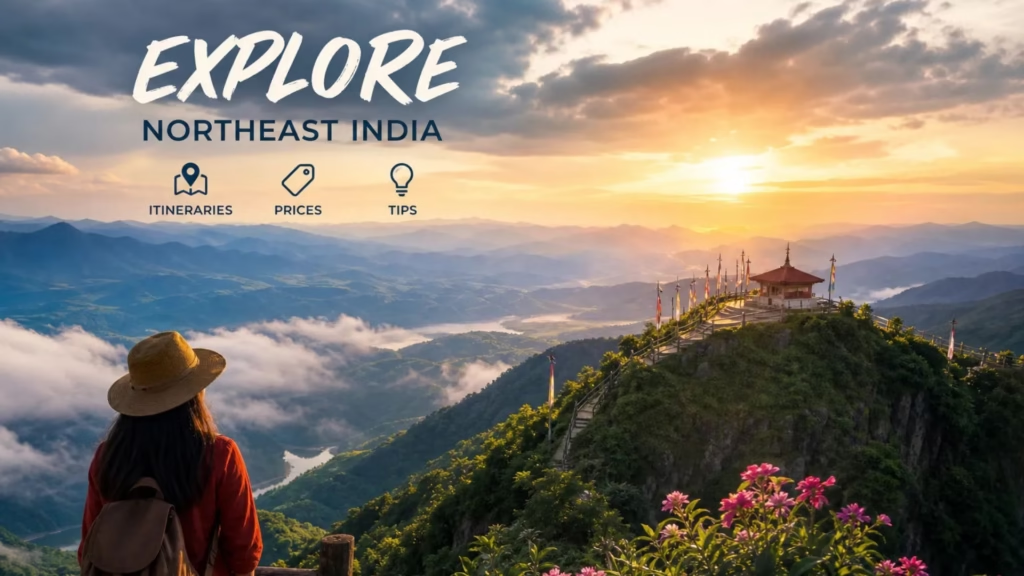
A Northeast India tour package can take you from the living root bridges of Meghalaya, plaited over centuries by the Khasi people into something that defies what you expect a bridge to be, to a one-horned rhino materialising slowly from the tall elephant grass of Kaziranga at first light. Or to the road to Tawang, cutting through cloud and rock at an altitude where the air itself feels like a different substance. These are not edited highlights from a travel magazine. They are the everyday reality of travelling through Northeast India, and they exist within a single circuit if you plan the sequence carefully.
The Northeast is not one destination. It is eight distinct states, Arunachal Pradesh, Assam, Manipur, Meghalaya, Mizoram, Nagaland, Tripura, and Sikkim, each with its own culture, landscape, and travel personality. Having planned Northeast India journeys for years, we at TourismBharat have seen one pattern repeat itself: the travellers who enjoy this region most are the ones who plan it right. The ones who don’t plan carefully enough often find themselves stranded on the wrong side of a cancelled transfer, or stuck at a checkpoint without the correct permit. This article gives you what you need to avoid that. By the time you finish reading, you will know which Northeast India tour package suits your timeline, what a fair price looks like in 2026, and exactly what to verify before you confirm any booking.
Why the Northeast is unlike anywhere else in India
The sheer geographic range of this region is what catches most first-time visitors off guard. Within a single multi-day drive, the landscape shifts from the Brahmaputra’s broad river plains to cloud forests dripping with rain, from high-altitude Himalayan passes to valley towns that feel like a different country. The biodiversity alone, anchored by Kaziranga’s greater one-horned rhinoceros and Manas’s tigers, makes this a genuinely world-class wildlife destination. Add the living cultures of Nagaland, the Buddhist monasteries of Sikkim and Arunachal Pradesh, and the root bridges of Meghalaya, and you have a circuit that no standard India itinerary can replicate.
The eight-state geography that changes everything
Guwahati is commonly used as the gateway to the region, thanks to its airport and proximity to Kaziranga National Park. Meghalaya sits just three hours from Guwahati and delivers the waterfalls, caves, and living root bridges of the Cherrapunji and East Khasi Hills area that fill most Northeast highlight reels. Sikkim and Arunachal Pradesh are the high-altitude Himalayan legs, with Gangtok and Tawang as their respective centrepieces. Nagaland is the cultural wild card, best experienced through Kohima’s war history and tribal village life, or timed around the Hornbill Festival in December. The distances between states are significant. So is road quality, and the order in which you visit matters as much as which states you include.
Why self-planned trips here go wrong most often
The friction points are real and specific. Arunachal Pradesh and Nagaland require an Inner Line Permit (ILP) for Indian nationals; foreign nationals need a Protected Area Permit (PAP). Neither permit is difficult to obtain, but both take time, and some destinations within Arunachal require additional clearances for specific border areas like Bum La Pass. Beyond permits, mountain roads can close at short notice, accommodation in smaller towns books out during festival periods, and flight connectivity outside Guwahati is limited. A packaged tour with an experienced operator is not a concession to laziness. In this region, it is genuinely the smarter logistical choice.
Best time to visit: how seasons shape your Northeast India tour package
The honest answer on timing is that the Northeast has two distinct travel personalities depending on the month, and knowing which one suits your plans will shape everything from your destination list to your budget.
October to April: the window that works for most routes
November through February delivers the clearest skies, the most reliable roads, and the best conditions for wildlife sightseeing. Kaziranga safaris run at their peak between November and April, when the grasslands thin out and rhino sightings become more predictable. Tawang becomes most accessible from October onwards, before winter snowfall makes the high passes unpredictable. One practical note: Meghalaya’s Cherry Blossom Festival in November drives up hotel rates and tightens taxi availability across Shillong. If you are travelling during that window, book accommodation and transport well in advance, ideally several weeks ahead, particularly around festival dates. The Hornbill Festival in Nagaland runs from 1 to 10 December 2026, and North East package deals that include Kohima during that period sell out early.
Monsoon travel: when the rain is actually worth it
June to September transforms Meghalaya’s waterfalls into something that photographs cannot fully capture. Nohkalikai Falls, already one of India’s tallest, becomes genuinely spectacular in full monsoon flow. That said, the trade-offs are real: mountain roads slow down considerably, some routes between states become unreliable, and multi-state itineraries become harder to execute cleanly. Monsoon travel works best for travellers whose sole focus is Meghalaya and the Assam lowlands, not for anyone trying to cover Arunachal or Nagaland in the same trip.
How the season affects your package price
Peak months from November to February push hotel rates and taxi costs higher, particularly around festival dates. Shoulder months, especially May and October, often offer a better deal while still delivering decent weather and road conditions. If you have flexibility on dates, the October shoulder period is particularly good value: the post-monsoon greenery is still vivid, crowds are lighter than peak winter, and accommodation prices have not yet caught up with demand.
Which northeast India tour package suits your trip length?
The Northeast works across three duration bands, each suited to a different type of traveller. Permit lead times, road distances, and the sheer variety of terrain mean that duration is not just about how much you want to see; it also determines which states are realistically reachable. Here is how to match your timeline to the right North East India holiday package.
Short escapes: 3, 4 days in Assam and Meghalaya
A 3 to 4 day circuit anchored on Guwahati, Shillong, and Cherrapunji is the natural entry point for first-time Northeast visitors or anyone working with a long weekend. The route covers Umiam Lake on the drive from Guwahati, Elephant Falls and Ward’s Lake in Shillong, and then Mawsmai Cave and Nohkalikai Falls in Cherrapunji. It is compact, road distances are manageable (Guwahati to Shillong is roughly three hours; Shillong to Cherrapunji another 90 minutes), and it gives a genuine taste of Meghalaya without overwhelming a short schedule. Price range for this circuit: ₹8,000 to ₹18,000 per person, depending on accommodation grade and whether a local guide is included. These figures reflect typical market estimates for 2026 and may vary by inclusion level.
The classic 6, 8 day circuit for most first-timers
The six to eight day format is the sweet spot for most travellers. A well-structured itinerary in this band covers Shillong and Cherrapunji, extends to Mawlynnong (widely known as Asia’s cleanest village) and the crystal-clear waters of Dawki, loops through Kaziranga for a jeep or elephant safari, and, if Sikkim is added, includes Gangtok and Tsomgo Lake as a final leg. This Kaziranga tour package extension is enough ground to feel like a proper Northeast journey without turning into a bus marathon. Price range: ₹20,000 to ₹35,000 per person. What pushes a package towards the higher end of this band is usually vehicle quality, accommodation tier, and whether permit handling is included for any restricted-area extensions.
Extended 10-plus day journeys into Arunachal and Nagaland
The longer circuits are for travellers who want to go deep rather than wide. Adding Tawang to a Meghalaya and Assam base means factoring in the long mountain drive through Dirang, acclimatisation time at altitude, and the permit processing lead time for Arunachal Pradesh. Connecting into Kohima and the Nagaland cultural trail adds another dimension entirely, particularly if the Hornbill Festival timing aligns. These offbeat North East tours require genuine flexibility because high-altitude road conditions and permit timelines do not always cooperate with a rigid schedule. Price range: ₹35,000 to ₹60,000 or more per person, reflecting the additional distance, accommodation nights, and specialist guide requirements. These are indicative market estimates for 2026; actual pricing will vary by operator and inclusion level.
What your northeast India tour package should actually include
Many travellers are not surprised by what a package includes. They are surprised by what it quietly leaves out. Here is how to read a northeast India tour package with proper scrutiny.
Standard inclusions across most packages
A properly structured Northeast India tour package provides all on-tour ground transport on a point-to-point basis (not vehicle-at-disposal throughout the day), hotel accommodation typically at a 3-star equivalent, and meals as specified in the itinerary rather than full-board throughout. Some packages include a local guide; many do not. This matters in a region where local knowledge, particularly around permit checkpoints and mountain road conditions, adds genuine value. Confirm the guide arrangement explicitly before booking.
Permits for restricted areas: do not assume the operator handles it
Arunachal Pradesh requires an ILP for Indian nationals. As of 2026, fees are reported at ₹300 for up to three days or ₹500 for longer stays, with validity of up to 14 days, but verify current figures on the official Arunachal Pradesh eILP portal before applying, as fees are subject to revision. Nagaland’s ILP costs ₹200 for Indian nationals and is valid for 30 days; again, confirm current rates on the official Nagaland ILP portal. Both permits can be applied for online through their respective state portals; applicants need a government photo ID and a passport-size photograph. The important point is this: not all operators bundle permit processing into the package price. Ask directly: “Does your quoted price include permit arrangement, and what are the lead times for approval?” This single question separates operators who have done these routes properly from those who treat permits as an afterthought.
Common exclusions that inflate the final bill
Almost no Northeast India tour package covers airfare or train fare to the entry city, travel insurance, tips, bottled water, entrance fees at national parks and monasteries, or activities added outside the stated itinerary. A ₹22,000 package can quietly become a ₹28,000 trip if these costs are not budgeted for in advance. Build a realistic buffer of 20 to 25 percent on top of the quoted package price to account for these predictable extras, particularly if your itinerary includes Kaziranga safari fees and monastery entry charges.
Reading the price tag: what a fair northeast India tour package costs in 2026
The three duration bands give you a reliable benchmark for 2026 market rates. What moves a package to the higher end within any band is consistent across operators: vehicle quality, accommodation tier, number of included meals, whether permits are handled by the operator, and the experience level of the local guide. The short 3 to 4 day band’s upper end reflects boutique accommodation and a dedicated guide; the 6 to 8 day band’s premium pricing typically signals a smaller group, a higher-grade vehicle, and permit management included. At the 10-plus day level, the price reflects complexity, multiple state crossings, specialist high-altitude guides, and the operational overhead of managing remote logistics.
Group departures vs private tours: what your money actually buys
Fixed-departure group packages offer the better per-person price because transport, accommodation, and operational costs are split across a group, and experienced operators have already negotiated bulk rates with hotels and vehicle providers. Private customised tours give you date flexibility and itinerary control, but cost noticeably more per person because you carry the full operational cost yourself. For first-time Northeast travellers, the group format offers something beyond price: a built-in support structure on difficult mountain roads and remote locations where a flat tyre or a closed pass is less stressful when handled by an experienced group leader rather than managed solo.
How to book a northeast India tour package without second-guessing yourself
The booking process is straightforward if you ask the right questions before you confirm anything.
The four things to verify before you confirm any operator
Run through these checks with any operator you are considering before committing:
- Does the departure date align with your travel window, including buffer days for weather delays on mountain routes?
- Is the accommodation grade clearly stated with no vague language such as “or similar” that gives the operator room to downgrade?
- Does the operator explicitly confirm permit handling for restricted-area destinations in the itinerary?
- What is the cancellation and rescheduling policy in writing, including the refund timeline?
These four checks will separate trustworthy operators from those who leave you chasing refunds months later.
Why fixed-departure group packages work especially well for this region
The Northeast’s combination of permit logistics, mountain road unpredictability, and peak-season accommodation pressure rewards operators who have run these circuits repeatedly. Many operators run regular fixed departures and plan specifically for permit lead times, meaning you can organise your trip around your work calendar rather than coordinating a complex custom itinerary from scratch. The operators who run these departures have already solved the sequencing, negotiated the hotel blocks, and built permit timelines into the booking window. That coordination has real value in this particular region.
Ready-to-book Northeast India tour packages from TourismBharat
At TourismBharat, our curated Northeast India group packages are built around the circuits described in this article: Meghalaya and Assam for shorter windows, and extended multi-state routes that add Sikkim, Arunachal Pradesh, or Nagaland for travellers with more time. All packages run on fixed departure dates with competitive INR pricing, group discount structures, and experienced local guides who know these routes in both peak and shoulder seasons. Permit assistance for Arunachal Pradesh and Nagaland is factored into the planning process as part of our coordination service, rather than left for you to navigate separately. If you’d prefer not to coordinate all of this independently, browse our Northeast India departures and you’ll find the structure already done for you.
Your next step: get on the right departure
You now have the framework to make confident decisions about any Northeast India tour package you encounter. You know which duration band fits your schedule, which states to prioritise based on your interests, what inclusions and permits to verify before signing anything, and what price range represents fair value in 2026. The Northeast rewards the travellers who arrive knowing what they are walking into, and it consistently exceeds expectations for those who do.
The practical next step is straightforward: match your available dates to a departure, run through the four verification checks with your operator, and build a 20 to 25 percent buffer into your budget for predictable extras. If you want to skip the research and go straight to a vetted option, explore TourismBharat’s North East India holiday packages, compare the departure dates to your calendar, and reach out to our team with any questions about specific itineraries. The living root bridges of the East Khasi Hills and the rhinos of Kaziranga are not going anywhere; the only variable is when you decide to go.