CHAT WITH US NOW!

Read this travelogue written by Shiva Aithal and access the traveller’s beautiful experience of visiting Koodalutheertha Falls!
It was a state holiday in Karnataka, and the kids demanded a long drive, and an unplanned trip was on the cards. We began from Udupi after breakfast, the kind of breakfast that settles the mind and allows the day to unfold without urgency. Udupi, when one steps out early, carries the scent of the sea even when it is not directly visible. The breeze travels between coconut palms and quiet streets. Nowadays, every morning is greeted with a light drizzle, and in no time, the sunrays seem to hasten their arms to dry them up quickly. The game of hide-and-seek between sun and clouds is common in this part of the world. The traffic is unhurried. It is a coastal town that shows the sea without raising its voice.
As I took out my car, Parijata flowers had adorned the bonnet overnight, as if they already knew about our today’s plans and were giving a ceremonial send-off. Thus, a royal trip was about to begin. Once we left the town, the road followed a steady rise in altitude. The change in landscape happened in a matter of minutes. At first, there were wide open fields and low-lying houses with sloping tiled roofs. Coconut groves lined both sides of the road. The light was bright and clear, with the lingering sharpness one often finds near the sea.
Then, not many kilometres later, the surroundings began to shift. The line of the horizon no longer had the flat calm of coastal land. The road started to wind, and the air grew thicker and slightly dimmer. Coconut palms gave way to areca and rubber plantations, and the skies seemed closer to the windshield. The change in the composition of humidity could be easily felt in the nostrils. It was the moment when one senses the beginning of the hills and the jungles before actually seeing them.
Soon after, the plantations themselves surrendered to the forest. Trees began to stand closer to one another, shutting out broad sunlight. As I drove through neat and clean serpentine roads, the filtered sunlight fell through the dense leaves. It also fell on our faces, and it appeared as if we were lit with yellow blinking disco lights, as we continued driving through thick and dense arms of trees. The change was not loud or dramatic. It was gradual, but clear. One could almost feel the coastline behind us and the Ghats ahead, welcoming us into a different world of sound and shade.
By the time we reached the parking area, it felt as though the sea was very far away, although time-wise it was still quite close. The Western Ghats hold moisture, depth, and shadow. The air carries the smell of wet bark and something old, as if the forest has witnessed many seasons repeating the same patient routine.
The trek to the waterfall began on a trail that dipped gently below the line of the trees. First, we had to cross a small stream before entering the jungle. This small venture was almost like an episode from the Squid Game series. The rocks beneath were a mix of slippery and rough surfaces. One foot on the disguised, misleading flat rock, the passer, who was just appreciating the gentle cool water beneath his feet, found himself flying in mid air, with both legs in the air for a second and a big thud on bums the next. As we moved ahead, the ground was covered with leaf litter that had softened over months. Moss grew on any surface long enough, undisturbed. Some of the tree trunks were coated in layers of lichen that formed natural patterns, like careful brush strokes.
Roots formed natural steps. They were thick and ancient, gripping the earth. One particular tree stood with roots spreading widely, its trunk rising straight as if carved from stone. Around it, younger trees leaned slightly, seeking space and light.
A tree, which Google suggested as “Lianas”, had looped in curious shapes. One had the form of a loop, while the other formed a question mark, which caught the eye immediately. It was as if the forest was quietly asking us to observe respectfully. The silence was not empty. It was filled with insect calls, soft rustling, and the constant distant note of moving water, all the way along.
The matter of leeches presented itself soon enough. They were small and quick initially on their legs and feet. They swelled into thick and undetachable, lazy blood suckers, without causing any indication of pain or mark with time. Some climbed almost unnoticed. We were fortunate to purchase from a local man, for twenty rupees, a stick with a lime wrapped in cloth tied to its end. A few firm taps with the lime bundle, and the leeches detached at once. At first, I had thought this was just another tourist spot business gimmick. However, it was no sooner than we realised that it was a helpful, practical skill that seemed to belong entirely to that place.
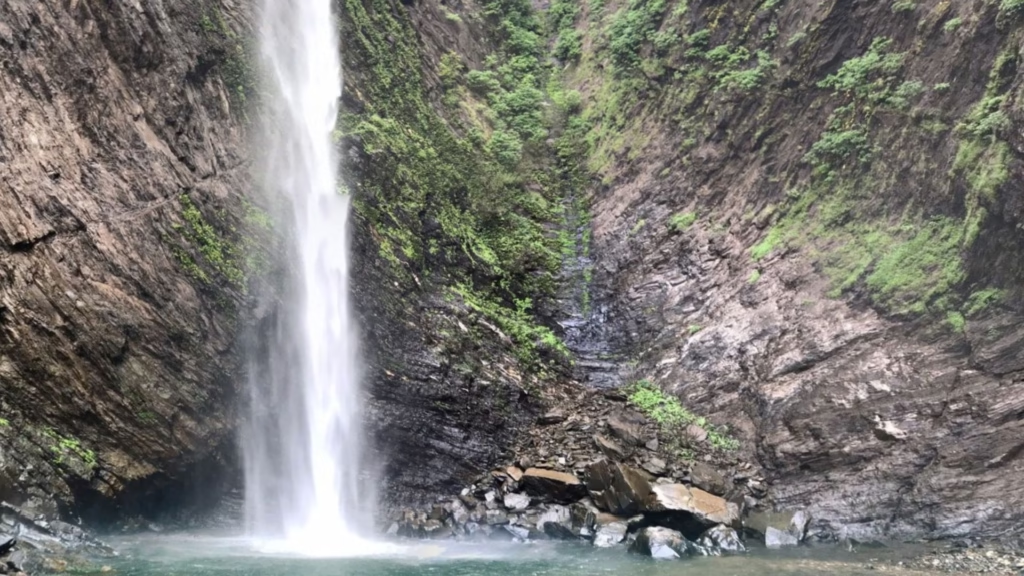
As we moved deeper, the waterfall’s sound grew clearer. It was not loud at first. It was present, steady, like a promise drawing us ahead. The final approach opened into a clearing where the water dropped in a single long sheet from the rock face above. Mist gathered at its base, rising lightly. The pool below was clear and cool. Many enthusiastic visitors kept their tired bodies directly under the falling water. The force of it was strong but refreshing. It woke every sense. We were contented with the constant fresh, jungle aroma fragrance mist, constantly sprayed by the cool breeze around the falls.
We rested by the flowing stream, placing our feet on smooth stones and letting the water move around them. The streambed was visible through the clear water. Small fish flickered and disappeared among the shadows. The sun touched the water in shifting fragments. My fully grown-up kids, once contented with the sight of water falling from a great height, started picking pebbles of various shapes and colours. Heeding the disapproval of their mother, mostly due to the added weight of transport back down the jungle, they did carry back home quite a bagful of those varied mineral souvenirs.
The return walk allowed even more observation. A cluster of bracket fungi arranged themselves like layered fans on a fallen log. The colours ranged from terracotta to pale cream. Young saplings pushed through decomposed wood, showing the quiet cycle of growth. The play of sunlight through the canopy changed constantly as the leaves shifted on their stems.
By the time we reached the vehicle again, my mind felt lighter. It was not a sense of achievement, but rather a sense of having been allowed into a place that does not change its pace for anyone. The drive back to Udupi reversed the transformation. The dense woods gradually loosened. The trees began to space out. Plantations reappeared. The air regained its salt. The sea breeze returned as if to greet us once more.
In the span of a single day, we had moved from the calm expanse of the coast to the quiet depth of the forest and back again. The experience felt complete, contained within the gentle rhythm of one journey and one landscape unfolding into another.